NOTHING SCALED DOWN
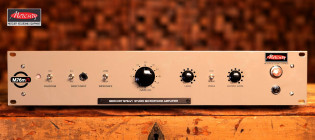
Paul Wolff took the microphone preamp out of the Wolff console and put it in one slot without scaling anything down. The custom Cinemag input and output transformers are the same. So is the relay controlled signal path for gain, pad, phantom and line, and the two gain stages with the output fader sitting between them. The op-amp is socketed, so you can run the one you like.
Paul puts it this way: “At its core, this is the exact mic pre from our console. Same transformers, same topology, same philosophy. We didn’t scale it down. We simply made it accessible.”
TWENTY dB OF ROOM BEFORE YOU TOUCH A CONTROL
Most mic pres start with gain already in the circuit. The W1 starts at zero: in zero gain mode the input transformer is padded 10 dB and the op-amp runs at unity, so the whole preamp sits about 20 dB below where most designs begin. Minus 20 in, minus 20 out. From there it steps up 10 dB at a time to +50, with a ±6 dB trim to land it, and you’ve got about 56 dB when the ribbon on the acoustic needs it.
WHY THE PAD IS THE LAST THING YOU SHOULD REACH FOR ON W1
A pad is a resistor network sitting between the mic and the input transformer. It loads both sides, both transformers settle down, and the sound gets tighter and drier. Sometimes that’s what you want, which is why the W1 keeps a relay switched pad.
Usually, though, you’re hitting the pad because the preamp ran out of headroom, and you’ve given up the loose, open sound of a mic talking straight to iron just to fix a level problem.
“You can put an SM57 two inches from a snare and hit it as hard as you want without needing a pad, and you don’t lose the sound.” And because the gain is stepped and the pad is a switch, you can flip between them and hear the difference while the drummer is still playing.
DRIVE THE FRONT. PROTECT THE CONVERTER
The fader sits between the two gain stages, so you can push the input side for tone and still hand the converter a sane level. “No impedance problems. No compromises,” as Paul puts it. A Neutrik combo jack on the front takes a mic or a bass straight in, and the console LED meter gives you −20 and +4 reference points plus a clip indicator. Andrew, on the meter: “You’d be amazed how many preamps there are out there that don’t have any indication of signal.”
SPECIFICATIONS
• Single-channel mic and instrument preamplifier, single 500 Series slot
• Circuit origin: the mic pre from Wolff Audio flagship consoles.
• Custom Cinemag input and output transformers, console-spec
• Socketed discrete op-amp
• Fully relay-controlled signal path — gain, pad, phantom, line switching
• Gain in 10 dB steps to 50 dB, ±6 dB trim, approximately 56 dB maximum
• Dedicated output fader between the two gain stages
• Neutrik combo input — XLR mic / unbalanced ¼″ (TS) instrument
• Relay-controlled 20 dB pad and +48V phantom
• Polarity reverse
• Console-derived LED metering — dual reference at –20 dB and +4 dB, intelligent release, clip indication, output dims during phantom switching
Read moreShow less




 English GB
 Français
Leave a review